
Sindh’s Waste Management: Turning a Decade of Experience into Lasting Progress
Each contract cycle should leave stronger facilities, usable operating knowledge and greater local capability.
The Sindh Solid Waste Management Board was established in 2014 with a mandate extending beyond appointing contractors. Its founding legislation encompassed sanitation services, infrastructure, planning, transfer, recycling and disposal. Contracting was a means of delivering that mandate; the larger responsibility was to develop a functioning waste management system. [1]
As Sindh approaches a decade of internationally contracted services, the question is what this experience has established for the future.
Engaging international operators offered a way to mobilise services while drawing on established expertise. Their participation brought visible investment in machinery, manpower and organised operations. These achievements deserve recognition. However, resources financed through service contracts do not, by themselves, demonstrate lasting improvements in local management or institutional capability.
The longer-term value should be evident in functioning workshops, dependable operating premises, maintenance systems, trained local professionals and usable service records. Public authorities should also become better equipped to plan, supervise and improve operations.
These benefits require defined objectives and funding. They cannot retrospectively be treated as obligations where agreements did not specify them. They should, however, guide the assessment of this contract cycle and the design of the next.
That assessment begins with a practical question: if the contracts ended today, what could the next operator use immediately—and what would have to be built again?
A transition review should establish the condition, ownership and continued availability of field offices, workshops, equipment and transfer facilities. It should also examine whether operating knowledge remains accessible beyond the people or companies that developed it.
The practical test is whether the next operator can use established maintenance procedures, route records, management systems and trained local teams. The authority should likewise retain reliable data and the professional capacity to supervise the next agreement.
Sindh’s assessment should recognise demonstrated achievements and investigate gaps in evidence. The next tender should begin with a clear inventory of what is available, what requires improvement and what the incoming operator must provide.
Lahore provides a relevant, though imperfect, comparison. LWMC took over vehicles and workshops associated with its Turkish contractors in December 2020. The circumstances were disputed, but the episode underlines the importance of assets and transition arrangements when agreements end. [2]
The lesson is to establish continuity before a transition becomes urgent. Usable facilities, records and experienced personnel should allow successive contracts to build on previous investment.
Yet even an experienced operator cannot establish a durable system without workable conditions for daily service. Equipment and overseas experience alone cannot resolve every local constraint. Service boundaries, public behaviour, access to facilities and timely client decisions all affect delivery.
In my view, doorstep collection interpreted as an unlimited obligation to remove waste placed outside at any hour is a luxury Pakistan cannot sustainably afford. Repeated clearance of newly deposited waste diverts resources from planned routes while streets can still appear unserved.
Each neighbourhood needs a defined arrangement: scheduled doorstep collection or accessible community points, with assistance for those unable to use them. These arrangements need public cooperation and consistent service from the operator.
The mixing of industrial waste with municipal waste is another issue that the service model must explicitly address. Industrial waste is not a single category: ordinary non-hazardous material and waste requiring specialised handling cannot be treated interchangeably. Contracts should define accepted waste streams, generator responsibilities and separate arrangements where needed. Collection teams should not be left to resolve unclear boundaries at the point of lifting.
These operating difficulties are compounded when payment incentives place greater emphasis on weight than service. In collection arrangements familiar to me, delivered tonnage is central to revenue, while attendance, fleet and other service requirements mainly attract deductions. This can reward weight more strongly than the service residents experience.
Consider two operators. The first completes its routes, maintains cleanliness and resolves complaints, but actual waste generation falls below the assumed tonnage. Its payment falls. The second delivers the expected tonnage despite weaker neighbourhood service; if the associated deductions are modest, it can receive more revenue than the first. This is an illustration of the incentive problem, not an allegation against a particular company.
Future tenders should balance verified coverage, cleanliness, complaint resolution and quantities handled. Recovery should also be recognised so that successful diversion from disposal does not undermine collection economics.
Changes to existing agreements should be voluntary, transparently costed and mutually agreed, preserving expected revenue for equivalent scope and performance.
Revising incentives also requires a workable relationship between the parties. Sanitation depends on the authority, contractor and public working together. In my experience, mobilisation and management changes can turn this relationship adversarial before operational difficulties are properly understood.
Incoming management should first examine existing commitments, constraints and procedures. Necessary reform should preserve useful experience and avoid disrupting services. Joint reviews, documented decisions and clear resolution deadlines would support this approach.
Financial discipline must work both ways. Wages, fuel and maintenance require continuous funding. Payments should be timely, and deductions should be evidence-based and tied to agreed provisions. Undisputed amounts should be paid while contested deductions undergo prompt review.
Contractors remain accountable for delivery; clients remain accountable for their decisions and payment obligations.
That cooperation must extend to the facilities on which operations depend. Waste management is a permanent service delivered through time-bound agreements. Land for parking, workshops, community collection points and transfer facilities should be planned accordingly.
The World Bank-supported SWEEP programme is an important investment. The Sindh government’s February 2026 update reported construction at four transfer stations and development of the Jam Chakro engineered landfill. These were reported works in progress, rather than confirmation of operational readiness. [3]
Infrastructure must also adapt throughout its working life. As neighbourhoods expand and commercial activity changes, collection points, capacity and routes need adjustment—just as a city’s traffic arrangements evolve.
Daily operating evidence should lead to timely decisions. Minor changes need delegated authority; larger improvements need technical assessment, land and funding. Changes affecting contractual scope or cost should be formally agreed.
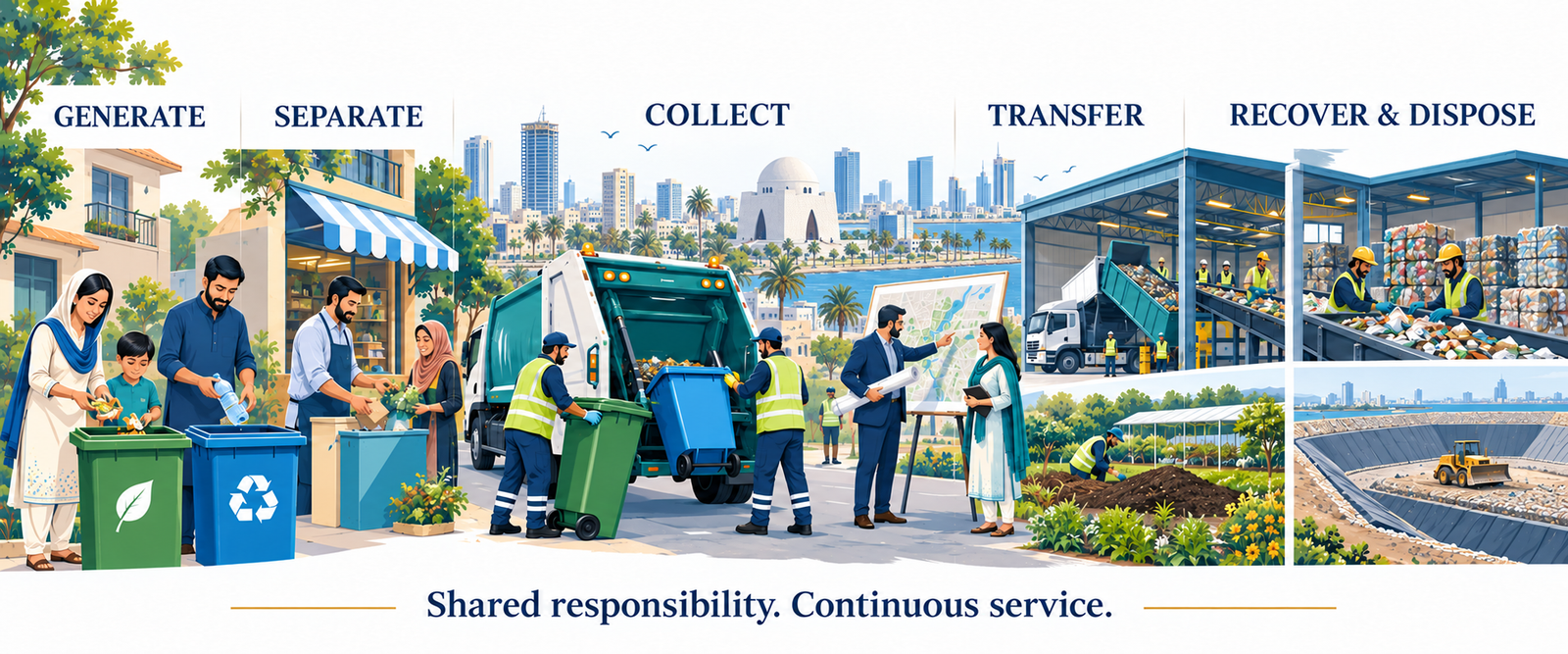
Town contractors could clean, collect and deliver to designated transfer stations. Appointed facility operators would manage reception and recovery, with clear responsibility for onward transport and final disposal. Each handover needs reliable records and arrangements for service disruption.
Wet-and-dry segregation should be introduced progressively and maintained during collection and transport. Recovery facilities must reflect actual material quality, operating costs and dependable buyers. Publicly supported facilities or suitable partnerships may be necessary where material sales cannot cover service costs.
With shared facilities in place, town-level packages could improve operational focus and create opportunities for capable local companies. Qualification requirements should be proportionate to each package while retaining firm service standards.
Localisation should develop management capability, maintenance expertise, suppliers and equipment manufacturing alongside employment. International operators can contribute through partnerships and structured knowledge transfer. The aim is a stronger local industry able to sustain and improve services.
Informal waste workers should be considered through voluntary, economically realistic arrangements that recognise their existing contribution and livelihoods.
The same approach must reach the people generating the waste. Residents and businesses are principal stakeholders, with responsibilities for waste separation, storage and proper disposal. They should follow agreed collection times and use designated facilities; operators and authorities must make those arrangements reliable and accessible.
Awareness must be continuous, supported by community organisations, schools and businesses. Consistent enforcement should follow once clear rules and usable services are in place.
Participation also carries a financial responsibility: those generating waste should bear an appropriate share of managing it, in line with the polluter-pays principle. Service charges should reflect the quantity and nature of waste, the service required and affordability considerations. Commercial and bulk generators require particular attention.
Charges for legitimate services and penalties for improper disposal serve different purposes. Littering and illegal dumping create additional costs that should not routinely be transferred to compliant residents or the public budget.
Any enforcement should operate under applicable rules, with evidence, proportionate penalties and a review mechanism. Paying a collection fee does not purchase permission to pollute.
Alongside fair service charges, the industry needs access to investment finance. Modern equipment and sustained operations cannot indefinitely depend on contractors financing everything from their own resources.
Banks and financial institutions should participate when projects are structured. Suitable contract periods, predictable payments and clear risk allocation can support equipment finance and working capital, subject to proper credit assessment.
Contractors must provide credible records and operational capability. Public authorities must provide dependable commercial arrangements. Affordable finance becomes more achievable when both fulfil their responsibilities.
Finance can provide equipment and facilities, but skilled people must make them work. The programme should also be assessed by the professionals it develops. How many graduates have received practical training, and how many now hold operational responsibilities?
Universities, technical institutions, SSWMB and operators should establish funded placements, supervised field experience and clear employment pathways. Training should produce demonstrated competence rather than attendance certificates.
Public monitoring teams need the same investment. Verified records and standardised inspections should carry greater weight than personal interpretation. Machinery tracking and weighbridges are useful, but neither alone establishes the quality of sanitation received by residents.
Before the next procurement cycle, Sindh should establish what each agreement has delivered and what will remain available afterwards. Future contracts should define the facilities, knowledge, skills and systems they are expected to develop, with funded milestones and clear transition arrangements.
The lasting value of international participation will be demonstrated by what Sindh can sustain and improve after an individual contract ends.